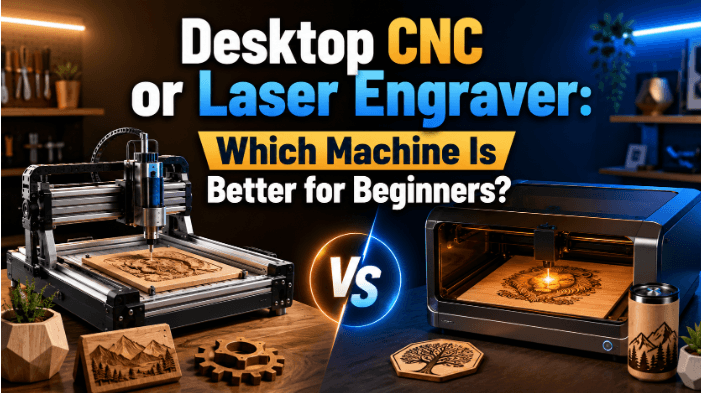
Why Beginners Often Compare These Two Machines
Anyone entering the world of digital making usually faces one common question: should they start with a CNC machine or a laser engraver? Both tools are popular, both can create impressive projects, and both are now available in compact desktop sizes. For beginners, this can make the decision confusing because the machines may look similar from a distance, but they work in very different ways.
A CNC machine cuts, carves, drills, or shapes material using a rotating tool. A laser engraver uses a focused beam of light to burn, mark, or cut material. One is based on physical contact with the material, while the other works through heat and light. Because of this difference, each machine has its own strengths, learning curve, safety needs, and best project types.
For people who are just starting, the right choice depends less on which machine is “better” and more on what they want to make. A beginner interested in wood carving may need one tool, while a beginner interested in personalized gifts may need another. Understanding the difference can save time, money, and frustration.
What a Desktop CNC Machine Does Best
A Desktop CNC machine is designed to remove material with a cutting bit. The machine follows a programmed path and carves into wood, plastic, acrylic, soft metals, or other compatible materials. This makes it useful for projects that require depth, shaping, cutting, or detailed carving.
A CNC machine is especially valuable for woodworking. It can create signs, nameplates, decorative panels, relief carvings, small furniture parts, custom molds, and accurate cutouts. Since the tool physically cuts into the surface, it can create three-dimensional effects that are difficult to achieve with simple surface engraving.
For beginners who enjoy hands-on building, CNC can be very rewarding. It teaches useful lessons about material strength, cutting depth, tool selection, and design accuracy. A user quickly learns that wood grain, bit size, feed speed, and clamping all affect the final result.
The learning curve is real, but it is not a reason to avoid CNC. Instead, it means beginners should start with simple projects before moving into complex designs.
What a Laser Engraver Does Best
A laser engraver is often chosen by beginners who want to create clean, detailed surface designs. It can engrave text, logos, patterns, photos, labels, and artwork onto compatible materials. It can also cut thin materials, depending on the machine power and material type.
Laser engraving is popular for personalized products. A small business owner can engrave names on wooden gifts, add a logo to packaging, create decorative signs, or mark custom designs onto leather, acrylic, cardboard, and other suitable surfaces. Because the laser does not use a cutting bit, it can create very fine visual detail.
For many beginners, a laser engraver may feel easier at the start. The process often involves preparing a design file, choosing power and speed settings, placing the material, and running the job. This does not mean there is no learning involved. Users still need to understand focus, ventilation, material safety, and burn settings.
The biggest strength of laser engraving is visual customization. If the goal is to create attractive designs on flat surfaces, a laser engraver can be an excellent first machine.
Comparing the Learning Curve
Both machines require patience, but they challenge beginners in different ways. A desktop CNC machine teaches more about mechanical cutting. Users need to understand tool paths, bit types, material holding, cutting depth, and machine movement. If the material is not clamped correctly or the cutting settings are wrong, the result can be rough or inaccurate.
A laser engraver has its own challenges. Beginners must learn how different materials react to laser power. Some materials burn cleanly, while others may discolor, smoke heavily, or produce poor results. Focus and speed settings matter. Ventilation is also very important because laser work can produce fumes.
In general, laser engraving may feel easier for simple projects, especially flat decorative work. CNC may take more time to learn, but it gives users stronger control over shaping and carving. A beginner who enjoys technical setup may appreciate CNC. A beginner who wants faster decorative results may prefer a laser engraver.
Materials Make a Big Difference
The choice between CNC and laser engraving often becomes clearer when beginners think about materials. A CNC machine works well with wood, plastic, acrylic, foam, and some soft metals, depending on the machine and cutting tool. It is ideal when the project requires cutting depth, carving, shaping, drilling, or removing material.
A laser engraver works well for surface marking and cutting thin materials. It is commonly used on wood, leather, paper, cardboard, acrylic, and some coated materials. However, users must be careful because not every material is safe for laser use. Some plastics can release harmful fumes, so material research is essential.
For woodworking, both machines can be useful, but the results are different. CNC can carve into the wood and create depth. Laser engraving can mark the surface with text or artwork. If a user wants carved signs, CNC may be better. If the goal is detailed surface decoration, laser engraving may be more suitable.
Read also: Why Every Business Needs an SEO Expert to Grow Online
Project Goals Should Guide the Decision
Beginners should avoid choosing a machine only because it looks popular online. The better approach is to think about actual project goals. A machine should match the type of work the user wants to do regularly.
A desktop CNC may be the better choice for:
- Wood carving and relief designs
- Cutting accurate shapes from solid material
- Making signs with depth
- Creating molds, panels, and parts
- Learning mechanical fabrication
- Working on projects that need structure and dimension
A laser engraver may be the better choice for:
- Personalized gifts
- Logo engraving
- Decorative surface designs
- Labels, tags, and packaging details
- Fast customization work
- Cutting thin sheets or lightweight materials
Some makers eventually use both because the machines complement each other. A CNC machine can shape the object, and a laser engraver can add text or decoration. For a beginner, however, starting with one machine is usually smarter.
Safety and Workspace Considerations
Safety should never be ignored, especially by beginners. A CNC machine produces dust, chips, vibration, and noise. Users need eye protection, proper clamping, dust control, and a stable work surface. Loose material can move during cutting and damage the project or the tool.
Laser engraving has different risks. Users need good ventilation, fire awareness, and safe material choices. A laser can ignite certain materials if settings are too strong or if the machine is left unattended. Smoke and fumes must be managed carefully.
Workspace also matters. CNC machines may need more cleanup because cutting creates dust and chips. Laser machines may need ventilation near a window or an exhaust system. Before choosing either machine, beginners should think about where they will use it and how they will manage mess, noise, and safety.
A machine that fits the workspace will be used more often and with more confidence.
Cost and Long-Term Value
The price of a beginner machine can vary depending on size, power, build quality, accessories, and features. However, the purchase price is not the only cost to consider. CNC users may need different bits, clamps, spoil boards, dust control tools, and replacement parts. Laser users may need ventilation accessories, protective surfaces, material samples, and safety equipment.
The better value depends on how often the machine will be used and what kind of projects it will support. A beginner who wants to sell engraved products may recover the cost of a laser engraver through personalized orders. A woodworker who wants to create carved signs or custom panels may get more long-term value from a CNC router.
It is also important to consider growth. A machine that feels slightly more capable than the user’s current skill level can be a good investment because it leaves room to improve. At the same time, beginners should not buy a machine so advanced that they feel overwhelmed before finishing their first few projects.
Which One Is Better for a Complete Beginner?
For a complete beginner, a laser engraver may be easier to start with if the goal is simple personalization, decorative work, and flat designs. It can produce attractive results quickly, and many first projects are easy to understand.
A desktop CNC may be better for beginners who are serious about woodworking, carving, and making physical parts. It may require more setup and practice, but it offers deeper creative and practical control. Users who want to understand materials, cutting, and dimensional design may find CNC more satisfying in the long run.
The best choice comes down to this simple question: do you want to decorate surfaces or shape materials?
If the answer is surface decoration, choose a laser engraver. If the answer is cutting, carving, and shaping, choose a desktop CNC.
A Smarter First Step for New Makers
Beginners should not rush the decision. A CNC machine and a laser engraver can both be excellent tools, but they serve different creative needs. The smartest first step is to choose the machine that matches the projects you genuinely want to make, not the one that seems more exciting for a moment.
A laser engraver is strong for fast customization, clean detail, and decorative work. A desktop CNC is strong for carving, cutting, woodworking, and shaped designs. Both can help beginners build skills, but the right machine will make learning feel more natural.
For new makers, the goal should not be to own every tool at once. The goal should be to start with the tool that supports real projects, encourages practice, and builds confidence. Once those first projects become successful, adding more machines later becomes a much easier and more practical decision.